If you have ever walked the Upper East Side and wondered why one block feels intimate and historic while the next feels grand, polished, or quietly modern, the answer is architecture. This neighborhood is not defined by one look. It is a layered residential landscape shaped over decades, from late-19th-century row houses to prewar apartment buildings, postwar landmarks, and newer towers that often nod to the past. If you are buying, selling, or simply trying to read the street more clearly, this guide will help you spot the major Upper East Side architectural styles and understand what they often mean for daily living. Let’s dive in.
Why Upper East Side Architecture Feels So Layered
The Upper East Side includes Lenox Hill, Yorkville, and Carnegie Hill, and its streetscape reflects that broad history. Landmarks Preservation Commission historic-district maps show several overlapping protected districts here, including the Upper East Side Historic District and Extension, Carnegie Hill and Expanded Carnegie Hill, the Metropolitan Museum Historic District, and the Park Avenue Historic District.
That matters because the neighborhood did not develop all at once. According to LPC historic-district reports, the area evolved from late-19th-century row houses into an early-20th-century apartment-house neighborhood, with the subway era permanently changing its architectural character. When you look closely, you can still see that transition on the street.
Townhouses and Row Houses
How to spot them
Townhouses and row houses are often the oldest residential buildings you will notice on the Upper East Side. They usually have narrow façades, rise three or four stories above a basement, and create a strongly vertical street presence.
Common visual clues include brownstone or brick façades, stacked windows, cornices, bay windows, and in some cases a stoop or signs of a former stoop. Even when a façade has been updated, the building often still reads as a narrow, layered house rather than a wide apartment building.
What they often tell you about living there
These homes were built for a very different pattern of living than a typical apartment house. The layout usually feels more private and vertical, with rooms spread across multiple floors rather than organized on a single level.
LPC reports also show that many Upper East Side townhouses changed over time. Stoops were sometimes removed, basement-level entries were added, and some buildings were converted to single-family or two-family use. That is why an older townhouse can show more than one era at once.
Upper East Side examples
On East 65th Street, LPC documentation highlights buildings such as 134, 138, and 140 East 65th Street. These began as Italianate brownstone-front houses in the 1870s and were later altered in revival styles.
That makes them especially useful examples. On one block, you can often see original 19th-century proportions alongside early-20th-century façade updates and later entry or roof changes.
Prewar Co-ops and Apartment Houses
How to spot them
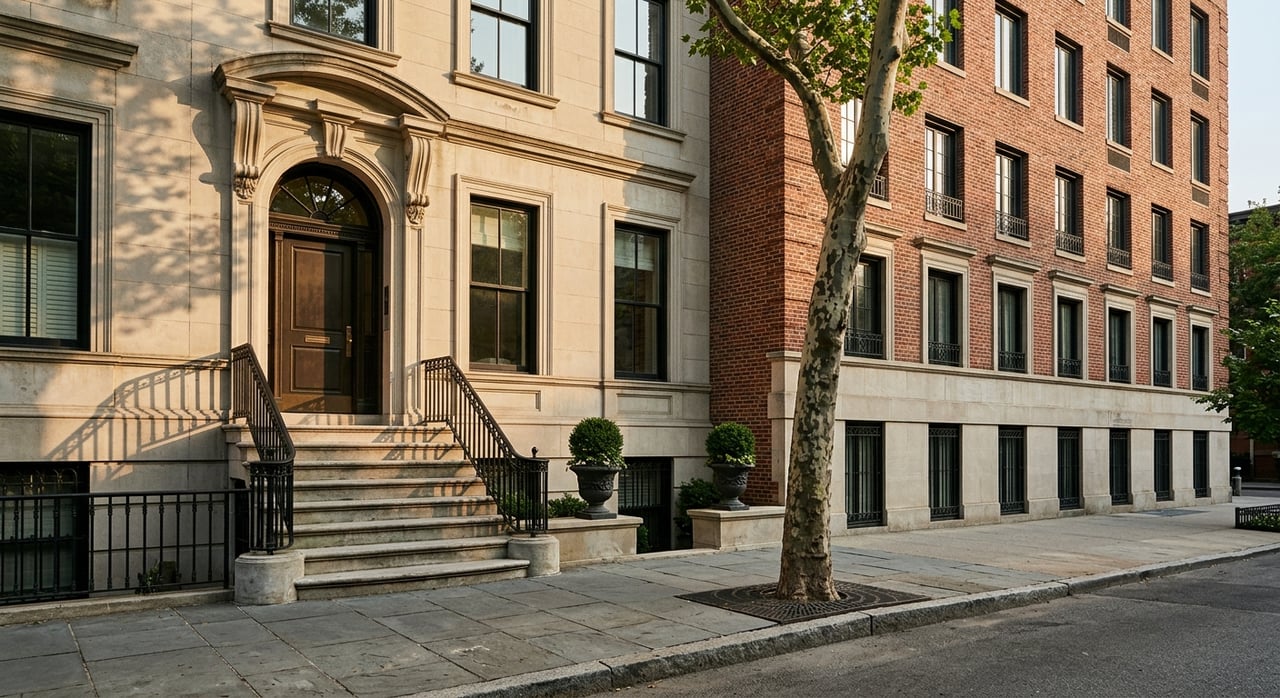
Prewar apartment houses are among the most recognizable Upper East Side building types. They often feature heavy masonry façades, limestone or terra cotta trim, strong cornices, centered entrances, symmetrical window patterns, and a clear base-middle-top composition known as tripartite massing.
These buildings became more common as apartment-house construction expanded after the subway era. LPC identifies Renaissance Revival and Colonial Revival apartment buildings as important parts of this shift, especially along Lexington Avenue and streets like East 72nd and East 73rd.
What they often tell you about living there
A prewar building often reflects a more formal interior plan. LPC records describe early examples with five to eight rooms, as well as larger apartments with eight, ten, or even twelve rooms.
In many of these homes, the layout separated entertaining areas from private rooms more clearly than many newer buildings do. Some were organized around a foyer rather than a long corridor, and certain plans even divided public rooms, bedrooms, and service spaces into separate zones.
Upper East Side examples
Useful local examples include 993-999 Lexington Avenue and 150 East 72nd Street, 117-123 East 72nd Street, and 1019-1029 Lexington Avenue and 145 East 73rd Street. LPC descriptions of these buildings point to the core prewar hallmarks: masonry façades, centered entries, and generously scaled room layouts.
For buyers and sellers, this helps explain why the term prewar carries so much meaning on the Upper East Side. It is not just about age. It often signals proportion, formality, and a distinct residential rhythm.
Postwar Buildings on the Upper East Side
How to spot them
Postwar architecture on the Upper East Side is more varied than many people expect. It does not always mean a glass tower or a stark modern façade.
A key example is Manhattan House at 200 East 66th Street, which the LPC dates to 1947-51. It is noted for its modern style, large scale, white brick exterior, large windows, cantilevered balconies, and landscaped driveway and garden.
What makes this style different
Manhattan House is especially important because it shows how postwar design began to prioritize light and air. Its H-plan was designed to avoid the darker courtyards common in earlier apartment-house forms.
That shift is one of the clearest visual and functional differences in postwar buildings. You may see lighter massing, larger windows, balconies or terraces, and more emphasis on openness rather than heavy street-wall formality.
Not all postwar buildings look modern
The Upper East Side also includes postwar buildings with a more traditional vocabulary. An LPC calendar notice identifies 680 Madison Avenue as a neo-Georgian apartment building designed by K. B. Norton and built in 1950-51.
This is an important reminder when you are evaluating the neighborhood. A postwar building here may look overtly modern, or it may present a more classic face that blends with older stone-and-brick streets.
Contemporary Towers and Contextual New Development
How to spot them
Newer Upper East Side buildings often borrow from prewar design instead of rejecting it. Rather than reading as simple glass slabs, many use brick, limestone trim, setbacks, terraces, and decorative references that help them sit more comfortably within the neighborhood.
Research examples include 150 East 78th Street, 255 East 77th Street, and The Bellemont at Madison Avenue and 86th Street. These buildings incorporate details such as rusticated bases, French balconies, loggias, curved corners, crowned tops, and brick-and-stone façades.
What they often tell you about living there
Inside, these buildings usually lean toward flexibility and light. Plans may include generous entry foyers, entertaining rooms arranged along a façade for better light, kitchens placed on outside walls, large closets, terraces, and shared amenity spaces.
That combination helps explain why some new Upper East Side towers still feel traditional in plan even when their construction is contemporary. The exterior may reference historic masonry architecture, while the interiors are designed for modern use.
A Quick Visual Checklist
If you want a simple way to read the streetscape, start with these clues:
- Townhouse or row house: narrow façade, three to four stories plus basement, brownstone or brick, stoop or former stoop, bay windows, cornice, and strong vertical presence
- Prewar co-op or apartment house: heavier masonry, tripartite façade, centered entry, limestone or terra cotta trim, formal lobby or foyer sequence, and larger multi-room layouts
- Postwar building: mid-century or revivalist character, larger windows, balconies or terraces, lighter massing, and more emphasis on light, air, and landscaped space
- Contemporary tower: setbacks, terraces, amenity floors, contextual stone or brick cladding, and flexible layouts that support entertaining and outdoor access
Why Architectural Style Matters When You Buy or Sell
On the Upper East Side, style is not only about curb appeal. It often points to a building’s original living pattern and helps set expectations for layout, privacy, scale, and the overall feel of the home.
A townhouse may offer vertical separation and a more private rhythm. A prewar co-op may appeal to buyers who value room scale and formality. A postwar building may emphasize openness and light, while a newer tower may combine contextual design with terraces, amenities, and flexible floor plans.
For sellers, understanding those distinctions can sharpen how your property is presented. For buyers, it can make your search more focused, especially when two homes in the same neighborhood offer very different living experiences.
If you are considering a purchase or sale on the Upper East Side, architectural context can be as important as square footage. For tailored guidance on townhouses, co-ops, condos, and architecturally notable properties across Manhattan, request a private consultation with James Weiss NYC.
FAQs
What defines Upper East Side townhouse architecture?
- Upper East Side townhouses and row houses are typically narrow, three or four stories above a basement, and often feature brownstone or brick façades, cornices, stacked windows, bay windows, and a strong vertical appearance.
What makes an Upper East Side building prewar?
- In this context, prewar apartment houses are generally early-20th-century masonry buildings with centered entrances, limestone or terra cotta trim, formal layouts, and larger multi-room apartments that reflect a more traditional living pattern.
Are all Upper East Side postwar buildings modernist?
- No. Some postwar buildings, such as Manhattan House, are clearly modern in style, while others from the same era use more traditional revivalist design language, including neo-Georgian features.
How do newer Upper East Side buildings fit the neighborhood?
- Many newer developments use contextual materials and forms, such as brick, limestone trim, setbacks, terraces, and decorative references to prewar architecture, helping them relate visually to the surrounding streetscape.
Why should Upper East Side buyers care about architectural style?
- Architectural style can offer practical clues about layout, room size, light, privacy, outdoor space, and the general living experience, which can help you compare properties more clearly.