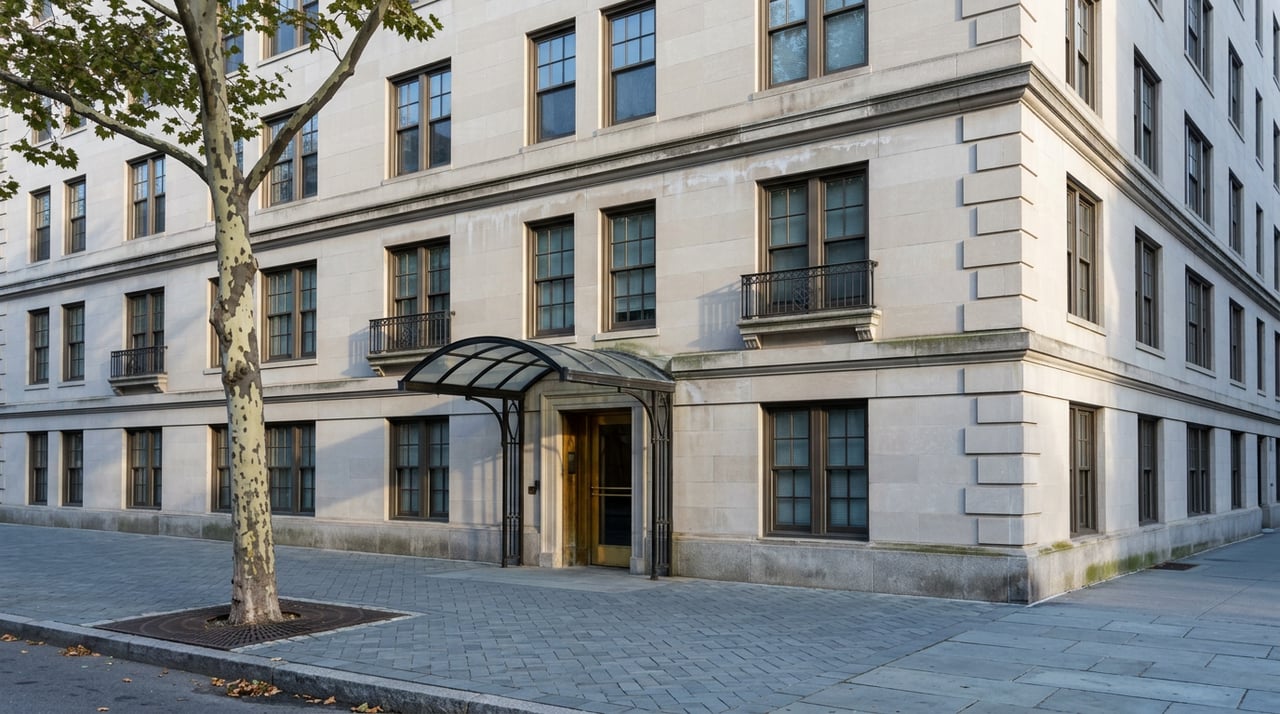
At 740 Park Avenue, the building's financing policy hasn't changed in decades. That policy was true before New York City passed a law meant to fix the co-op approval process. It is still true seven weeks after that law took effect.
On July 28, 2026, New York's Cooperative Application Timeline Law, known formally as Local Law 58 of 2026, went into force. The City Council passed it by a wide margin in December 2025, the mayor vetoed it, and, as Habitat Magazine reported, the Council overrode that veto on January 29, 2026. According to ALB Law Firm, the law now governs every co-op purchase application submitted in a building with more than ten units. For buyers who have spent years hearing "the board will get back to you" with no fixed date attached, that is a real structural change. It is also, for anyone shopping the Upper East Side's most established Park and Fifth Avenue buildings, a change that arrives at the wrong layer of the problem.
The Clock Nobody Had Before
Local Law 58 does two specific things. First, once a buyer submits a board package, the co-op has 15 days to confirm that the file is complete or to list exactly what's missing. Second, once a package is complete, the board has 45 days to issue a decision: approve, approve with conditions, or deny. Boards get one 14-day extension. According to GDB Law, buildings that go quiet over the summer can adopt a formal recess policy that pauses both clocks in July and August.
According to Kucker Marino, missed deadlines can bring HPD civil penalties of $1,000 to $2,000. What it buys a buyer is a number to plan around instead of an open-ended wait.
That is worth something. For anyone timing a co-op purchase against the sale of an existing home, a defined timeline for board review, turns a guessing game into a closing calendar. Condos were never subject to this uncertainty in the first place, since, as Staten Island Law explains, most already carry right-of-first-refusal timelines in their bylaws, which is part of why the new law applies only to cooperatives.
The Discount the Clock Doesn't Touch
Here is the part the law leaves entirely alone: whether the board says yes.
Citywide, co-op board rejection has historically run in the 3 to 5 percent range of all applications submitted. On prewar co-ops along Park Avenue, Fifth Avenue, and Central Park West, that figure climbs to an estimated 10 to 20 percent. The gap isn't about paperwork speed. It's about the financial bar those specific boards set before a file even reaches a vote, and Local Law 58 does not touch a single one of those thresholds.
Those thresholds are steep by design. Many prewar Fifth and Park Avenue buildings ask for post-closing liquidity equal to one to three years of combined mortgage and maintenance payments, sitting in cash or marketable securities, not just on paper. At the ultra-luxury tier, above roughly $10 million, some boards informally expect a purchaser's net worth to run five to ten times the price of the apartment. Debt-to-income ceilings have also tightened. Ratios that comfortably cleared board review in 2021 and 2022, in the 30 to 35 percent range, are drawing pushback in 2026, with some boards now holding the line closer to 25 to 28 percent. FICO minimums follow the same pattern: a general floor of 720 or so citywide, with some Fifth and Park Avenue buildings pushing toward 780 to 800.
That underwriting discipline shows up in price. Co-op inventory across the Upper East Side posted a median sale price of roughly $825,000 in the fourth quarter of 2025, against a median condo price near $1.66 million over the same window. Price per square foot tells a similar story: co-ops traded in the neighborhood of $1,150 to $1,300 per square foot, while condos ran closer to $1,800. That spread is not a knock on the buildings themselves. It reflects the buyer pool a strict board can access, since financing limits, subletting restrictions, and a discretionary interview all shrink the field before a single showing happens.
Here's what changed on July 28 and what didn't:
| What the law changes | What stays the same |
|---|---|
| Board must confirm a complete application within 15 days | Board approval remains uncertain |
| Decision must arrive within 45 days of a complete file, plus one 14-day extension | Liquidity, DTI, and net worth thresholds are set building by building, not by the city |
| A missed deadline can trigger an HPD civil penalty of $1,000 to $2,000 | Board approval remains a separate question |
| Applies to co-ops with more than 10 units | 740 Park Avenue's financing policy is unaffected |
| Boards may adopt a written summer recess policy for July and August | Rejection rates at prewar Park and Fifth Avenue buildings remain well above the citywide norm |
Why Park and Fifth Avenue Boards Run Differently
The Upper East Side isn't one market, and its co-op stock makes that clearer than almost any other segment. Carnegie Hill, roughly 86th to 96th Street between Fifth and Lexington, carries the highest price tags on the strip, with co-op medians near $2 million and condos closer to $3.1 million. Lenox Hill, Yorkville, and Sutton Place each run their own rhythm, with different building ages, different board temperaments, and different price floors, even within a few blocks of each other.
What ties the prime Fifth and Park Avenue buildings together is architectural pedigree as much as address. A meaningful share of the neighborhood's most guarded co-ops, including addresses tied to architect Rosario Candela, were built in the prewar era specifically to attract long-term, owner-occupied residents rather than a broad resale market. That original design intent still shapes board culture nearly a century later: formal interviews, deep scrutiny of liquidity and work history, and buildings like 740 Park Avenue that simply take financing off the table.
None of that is new because of Local Law 58. It predates the law and will outlast it. What the law changes is how long a buyer waits to hear the answer, not how hard that answer is to earn.
What This Means If You're Board-Shopping This Fall
A buyer targeting a Park or Fifth Avenue co-op this fall should treat the new timeline as a planning tool, not a softening of standards. A complete, well-organized package still matters more than it did before, because the 15-day completeness clock now runs whether or not the board is ready for it. A thin file can still work against a buyer who submits a rushed package to "start the clock."
The financial preparation gets more important, not less. Boards that have tightened DTI expectations and liquidity requirements over the past two years show no sign of loosening them just because they now face a filing deadline. If anything, a board under statutory time pressure has more incentive to deny a marginal file quickly than to spend weeks negotiating conditions.
Co-op contract activity across the Upper East Side was down roughly 15 percent year over year in early 2026, which has created real negotiating room on price for buyers willing to engage with the product type. That combination, softer pricing plus a firmer timeline, is a genuine opening. It is not, however, a reason to walk into a 740 Park Avenue or comparable building underprepared on the financial side. The clock got shorter. The bar didn't get lower.
Frequently Asked Questions
Does Local Law 58 mean a co-op board can no longer reject a buyer? No. The law regulates timing, not outcomes.
What happens if a board misses its 45-day deadline? A missed deadline can bring HPD civil penalties.
Does this law apply to condos? No. Local Law 58 applies specifically to cooperative corporations with more than ten units. Condominiums already operate under right-of-first-refusal timelines written into most buildings' bylaws, which is part of why the City Council limited this law to co-ops.
For buyers weighing a Park Avenue co-op against the newer timeline, or trying to read what a specific building's board culture actually looks like beyond what's written in the offering plan, that context is exactly where a longtime Upper East Side team earns its keep. The James Weiss Team works these buildings and their boards directly. Request a private consultation to talk through where your file stands before you submit it.
This article is general information, not legal, tax or financial advice. Consult a qualified professional about your situation.