Welcome to
2,868 people live in NoHo, where the median age is 40 and the average individual income is $176,681. Data provided by the U.S. Census Bureau.
Total Population
Median Age
Population Density
Average individual Income
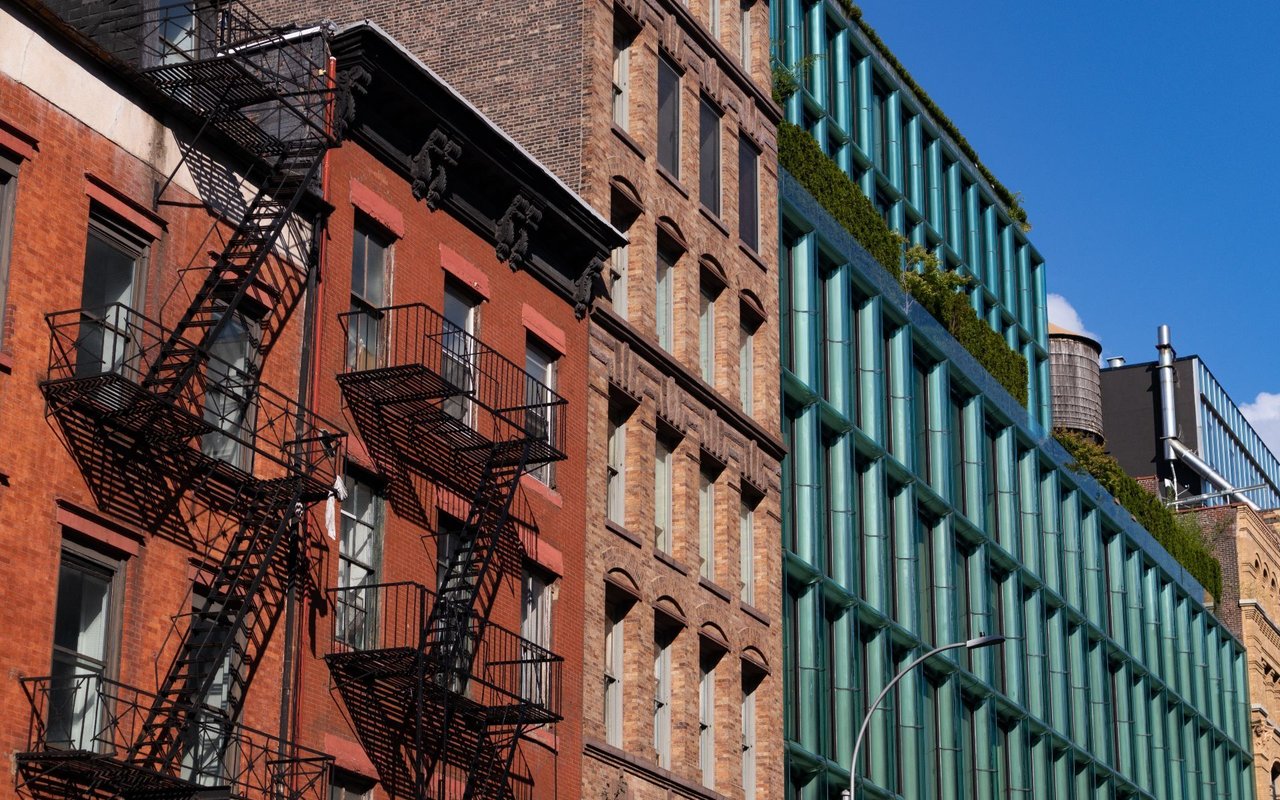
NoHo (North of Houston) is one of Manhattan's smallest and most quietly powerful neighborhoods — a 21-block historic district where 19th-century cast-iron warehouses now house some of downtown's most coveted lofts and starchitect-designed condos. For buyers who want the architectural drama of downtown without the foot traffic of SoHo or the energy of the East Village, NoHo offers something rare in Manhattan: privacy, scale, and a permanent ceiling on new supply.
This guide breaks down what we have learned advising clients through dozens of NoHo transactions — the market dynamics, the legal quirks, the day-to-day reality, and the trade-offs that only become clear once you have walked these blocks at every hour of the day.
NoHo is a market that does not behave like the rest of Manhattan, and that is a feature, not a bug. Because the entire neighborhood spans only a handful of blocks, a single closed sale at an address like 40 Bleecker or 25 Bond Street can shift the neighborhood's median pricing data overnight. The current median listing price hovers around $3.9M to $4.1M, with a premium price per square foot of roughly $2,450 — but those numbers should always be read with the understanding that NoHo is too small to behave like an "average."
What we are seeing on the ground is a strategic buyer's market emerging out of the post-pandemic luxury correction. Prices have recalibrated roughly 20% from their 2021–2023 peaks, and the average days on market has stretched to around 74 days. For buyers, this means meaningful negotiating leverage — time to audit building financials, evaluate board minutes, and avoid the frantic bidding environment of two years ago.
Looking forward, we do not anticipate a price crash here. NoHo's protected landmark status guarantees a permanent supply cap, and as interest rates stabilize, sidelined luxury buyers are quietly returning. Well-priced turnkey properties are already moving quickly; raw or "compromised" lofts will continue to require realistic seller expectations.
The single most common question we field from downtown buyers is whether to plant their flag in NoHo or SoHo. The two neighborhoods sit shoulder-to-shoulder but offer radically different daily realities.
Feature | NoHo | SoHo |
|---|---|---|
Core vibe | Residential, understated, artistic — a hidden-in-plain-sight enclave | Bustling, high-energy, globally famous fashion and cultural epicenter |
Foot traffic | Subdued and local; cobblestone streets like Bond stay quiet on weekends | Extremely high — heavy tourist flow on Broadway, Spring, and Prince |
Architecture | Romanesque/Renaissance Revival brick, modern starchitect condos, classic lofts | The world's largest collection of cast-iron architecture |
Inventory | Boutique luxury condos and new-construction sponsor units alongside historic lofts | Predominantly historic co-ops and open-concept artist lofts |
Zoning | Simpler residential transactions, subject to LPC rules | Many lofts still designated JLWQA (artist live-work), requiring legal navigation |
Pricing power | Slight premium PSF for ultra-luxury new builds; relative value vs. SoHo legacy | Massive premium driven by global brand equity |
The cleanest way to think about it: choose NoHo if you want the architectural scale of downtown loft living but prioritize privacy, quieter weekends, and a more straightforward condo purchasing process. Choose SoHo if you thrive on energy, want world-class retail at your doorstep, and specifically desire a romantic cast-iron co-op loft — even if it means navigating stricter boards and artist zoning.
In most Manhattan neighborhoods, luxury is a segment. In NoHo, luxury is the entire market — and within it sits a distinct ultra-high tier that operates by its own rules.
Entry-level luxury in Manhattan generally begins around $2M to $4M, but NoHo's premier tier regularly starts at $8M and climbs past $25M. This segment is dominated by full-floor lofts, starchitect-designed new developments like 40 Bleecker, and discreet legacy buildings like 25 Bond Street. Roughly 75% to 85% of closed deals at this level are all-cash transactions, which insulates the top of the market from mortgage rate volatility and explains why pricing here has held firm even as the broader market normalized. Pristine, turnkey ultra-luxury spaces routinely breach $2,800 to $3,200+ per square foot.
What buyers should understand is that the "turnkey premium" in NoHo is enormous. Strict Landmark Preservation Commission rules and elevated construction costs make renovations long and expensive, so move-in-ready spaces command a disproportionate markup — while raw, unrenovated lofts sit on the market significantly longer. If you have the appetite for a renovation, that gap is where genuine value lives.
NoHo offers investors a distinct risk-reward profile: elite capital preservation and bulletproof tenant quality, but compressed immediate yields. If you are optimizing for cash-on-cash return, this is not your neighborhood. If you are optimizing for long-term wealth preservation backed by structural supply scarcity, few Manhattan submarkets compete.
Net cap rates in NoHo typically sit between 2.5% and 3.2% — in line with most of prime Manhattan. Median rents land around $6,350 to $6,400 per month, with luxury two-bedroom condos commanding $9,000 to $15,000+. Vacancy rates stay below 2.5%, and the typical tenant profile (corporate executives, high-net-worth individuals) makes for an exceptionally clean rental experience. Historically, prime Manhattan condominiums have appreciated at roughly 5% to 6% annually — and NoHo's protected historic district status means new inventory cannot meaningfully expand.
The fix-and-flip strategy, however, is nearly impossible to execute here. Landmark approvals for facade or structural changes can consume 12 to 18 months in holding costs alone. Co-op boards often impose flip taxes of 1% to 2% of gross sale price and restrict subletting. The investors who win in NoHo practice a "buy, hold, and add value" strategy — acquiring quality lofts, executing high-end interior renovations, renting to carry costs, and selling years later into the next upswing.
Buying in NoHo demands a different posture than buying in a standard high-rise neighborhood. The market rewards preparation and legal precision over speed.
You will encounter three main property types. The authentic loft — converted 19th-century commercial buildings with massive volume, exposed brick, and original timber or cast-iron columns — anchors the historic inventory and often sits within older co-op structures. Boutique luxury condos like 40 Bleecker and 25 Bond Street offer industrial scale with modern layouts, discreet amenities, and far simpler purchase processes. Finally, rare townhouses and mews properties hide down cobblestone alleys like Great Jones Street, trading hands quietly and often off-market.
Competitiveness varies sharply by property quality. Turnkey, well-lit, properly renovated units still attract immediate all-cash offers. "Compromised" spaces — deep lofts with limited rear light, units facing East Houston — sit longer and offer real negotiating room.
Two contingency realities to internalize before you make an offer: in competitive luxury situations, financing contingencies are rarely accepted, so mortgage buyers typically need to submit non-contingent offers backed by strong pre-approvals. Due diligence contingencies, on the other hand, are standard and essential — your attorney will spend the pre-contract period auditing building financials, reading years of board minutes for looming capital projects, and verifying structural integrity. In a neighborhood of buildings averaging well over a century in age, that work matters.
NoHo's charm comes from its industrial history — but that history leaves a trail of legal and structural quirks that can derail an uneducated buyer. There are four things every buyer should understand before signing.
The first is JLWQA artist zoning. Historically, vast portions of NoHo were zoned strictly for Joint Living-Work Quarters for Artists, meaning a resident had to be a certified artist through the NYC Department of Cultural Affairs. After major rezoning and a New York Court of Appeals decision, non-artist buyers can now legally convert a JLWQA loft to standard residential use by paying a one-time municipal conversion fee calculated by square footage. Your attorney must confirm whether a unit has already been converted, or whether you need to price the conversion fee into your acquisition cost.
The second is landmark bureaucracy. Nearly all of NoHo sits within a designated Historic District, giving the Landmark Preservation Commission absolute jurisdiction over building exteriors. Window upgrades, terrace additions, or facade modifications require an arduous, months-long approval process. Add to this the boutique-building math: many NoHo buildings contain fewer than 10 to 15 units, so when a roof or facade project hits, the per-unit capital assessment can easily reach five or six figures.
The third is loft law and Certificates of Occupancy. Never assume an apartment is legally cleared for residential use. Some NoHo buildings are still transitioning out of NYC Loft Board jurisdiction. Your attorney must verify a clean, valid residential Certificate of Occupancy — an open or interim C of O can paralyze mortgage approval and refinancing down the line.
The fourth is flood zones, which is actually a positive. NoHo sits on high, stable ground and is removed from FEMA's primary flood hazard zones. You will not face the flood insurance mandates or climate-resiliency retrofits affecting waterfront neighborhoods like Tribeca or the East Village — a quiet but meaningful long-term structural advantage.
Living in NoHo is the rare experience of a quiet epicenter. The neighborhood sits between the high-octane energy of SoHo, the bohemian pull of the East Village, and the academic hum of Greenwich Village — yet inside its borders, it functions as a private, almost secretive micro-neighborhood.
The day-to-day cadence is intensely local. On a Tuesday morning, the neighborhood belongs to its residents — people walking dogs down the Belgian blocks of Bond and Great Jones, grabbing espresso at La Colombe, picking up groceries. There is no commercial crush, no tourist density. It feels, genuinely, like a village.
Culturally, you live inside a three-block radius that includes some of the city's most relevant dining and design destinations. The Public Theater anchors the neighborhood's intellectual energy on Lafayette. And logistically, NoHo is arguably downtown's best-connected pocket — the B, D, F, M, and 6 trains converge at Broadway–Lafayette, putting Wall Street and Midtown each under 15 minutes away.
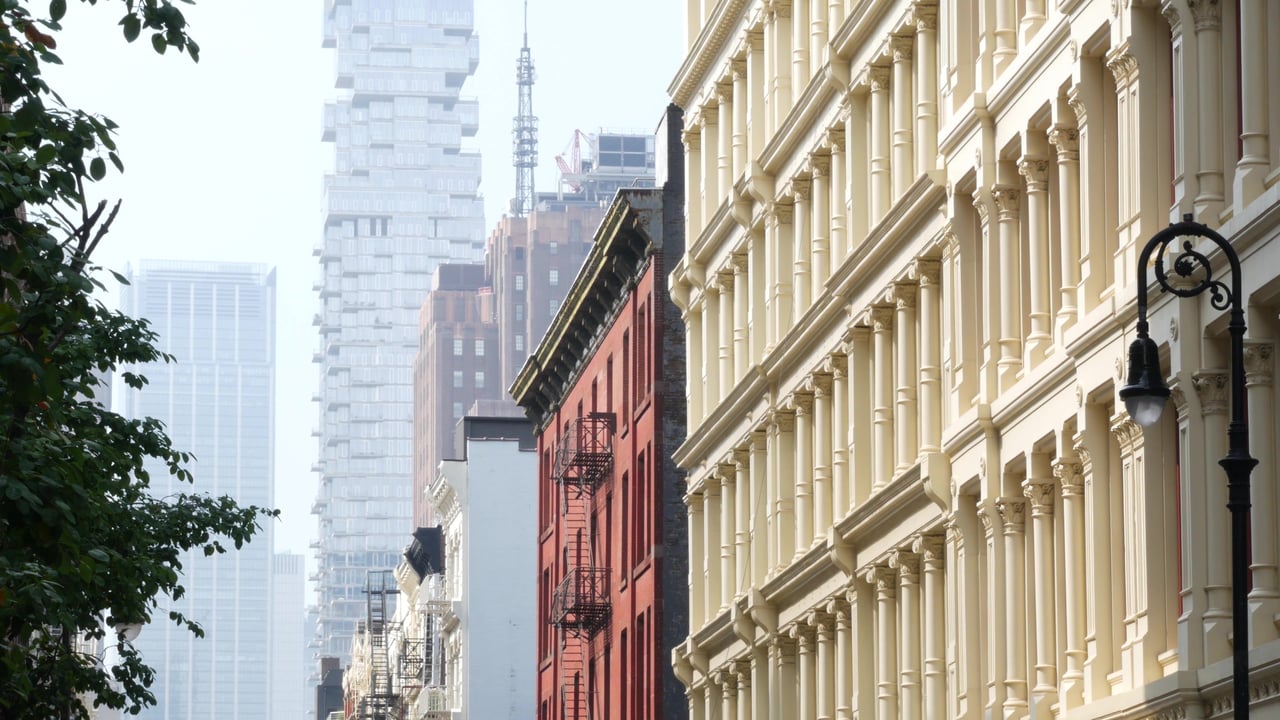
For buyers with strong aesthetic preferences, NoHo is a study in texture, volume, and juxtaposition. The Historic District designation ensures the 19th-century industrial identity stays intact, even as it sits alongside striking modern architecture.
The dominant baseline is Romanesque Revival and Renaissance Revival — heavy brick and terra-cotta facades, deep-set arched windows, rusticated stone bases, elaborate roof cornices. The Puck Building is the archetype. Inside these structures, residential conversions deliver soaring ceilings of 11 to 14 feet, exposed timber beams, structural brick arches, and load-bearing cast-iron pillars.
Tucked on quieter cross streets, you will find rare remnants of New York's early-19th-century elite residential era — most famously Colonnade Row on Lafayette Street, with its sweeping Corinthian columns. Units inside these legacy buildings often carry historic marble fireplaces and old-world floor plans that simply do not exist elsewhere.
What truly elevates NoHo's architectural market is how seamlessly it integrates ultra-modern design into the historic grid. With vacant lots scarce, elite architects had to design contextually. 40 Bleecker uses blackened steel and glass to nod to industrial roots while delivering light-flooded condos; 25 Bond Street is a masterclass in chiseled granite. These buildings serve buyers who love NoHo's location but want floor-to-ceiling glass, acoustic soundproofing, smart-home automation, and full-service amenities that 150-year-old lofts cannot support.
NoHo carries a Walk Score of 100, and the lived reality matches the number. Because the neighborhood spans only a few blocks, errands require minimal effort — gourmet grocers, dry cleaners, gyms, and medical practices are baked directly into ground floors throughout the grid.
The single greatest logistical asset is the Broadway–Lafayette / Bleecker Street station complex, pinned right in the center of the neighborhood. It grants direct access to the B, D, F, M, and 6 trains — a ride to Rockefeller Center or Grand Central takes 12 to 15 minutes; the Financial District is under 10. The N, R, and W trains sit just a block north at Astor Place as backup.
For cyclists, protected bike lanes run north-south along Lafayette and the Bowery, providing dedicated paths into downtown or up to Union Square. Citibike docks are densely scattered across nearly every corner, which makes micro-mobility a genuine primary commuting method here, not an afterthought.
NoHo's real estate premium is directly tied to its origins. The neighborhood has undergone three distinct transformations that explain its current identity.
In the early 1800s, fur magnate John Jacob Astor purchased the land and carved it into one of New York's most exclusive residential enclaves. Bond, Bleecker, and Great Jones were the Millionaire's Rows of their era — and Colonnade Row on Lafayette Street, with its grand Corinthian columns, stands today as a direct monument to the period when NoHo was the city's grandest address.
By the mid-1800s, as the elite migrated uptown, NoHo transformed into Manhattan's primary dry-goods textile capital. Renowned architects were commissioned to build grand store-and-loft buildings using marble, limestone, cast-iron, and terra-cotta — the massive warehouses that still define the neighborhood's skyline.
Manufacturing left Manhattan by the mid-20th century, and artists quietly reclaimed the abandoned floor plates as live-work studios. Recognizing the architectural significance, the city officially designated the NoHo Historic District in 1999 and expanded it in 2008 — permanently protecting 21 contiguous blocks from demolition and creating the structural supply cap that drives today's ultra-luxury market.
For family buyers, the school landscape is one of NoHo's quieter strengths. The neighborhood sits within Manhattan's Geographic School District 2, widely regarded as one of the highest-performing and most resource-rich public districts in New York City.
Because NoHo is geographically small, it shares zoning with Greenwich Village and SoHo. Most of the neighborhood is zoned for P.S. 41 (The Greenwich Village School) or P.S. 3 (The John Melser Charrette School) — both excellent, with P.S. 41 particularly known for its strong parent association, test scores, and arts programming. For middle school, District 2 uses a choice-based admissions model rather than strict zoning, opening access to institutions like Baruch Middle School (M104) and the highly competitive Clinton School.
At the high school level, NoHo residents benefit from proximity to specialized schools like Stuyvesant (a quick subway ride downtown) and Eleanor Roosevelt on the Upper East Side. On the private side, Grace Church School — a prestigious PK-12 independent school — sits just on NoHo's northern border, and the academic gravity of NYU at the western edge keeps the neighborhood well-lit, well-monitored, and intellectually engaged year-round.
NoHo does not have a sprawling green footprint — instead, its outdoor character lives in pocket parks, immediate proximity to major green space, and direct access to waterfront recreation.
Inside the neighborhood, DeSalvio Playground (just south at Spring and Mulberry) serves as the primary local spot for toddlers and young children, and Mercer Playground on the western edge offers open space and asphalt play yards. But the real backyard is Washington Square Park — a 5-to-10-minute walk from anywhere in NoHo, with large playgrounds, dog runs, open lawns, and the cultural energy of NYU's campus.
For runners and cyclists, the Bowery and Lafayette bike corridors connect directly north to Union Square and south to Chinatown, and both the Hudson River and East River waterfront greenways are reachable within a 15-minute jog — giving NoHo residents access to miles of continuous waterfront trails without living next to the water.
NoHo's hospitality scene is a definitive lifestyle signal. This is not a neighborhood of commercial chains or sports bars — it is downtown's premier stage for high-concept, design-forward dining and discreet evening salons.
The culinary footprint includes some of the most competitive reservations in the country. Torrisi inside the Puck Building delivers Michelin-starred Italian-American luxury on a grand stage; Lafayette Grand Café & Bakery anchors the daytime power-lunch crowd with a cinematic French brasserie; Il Buco on Bond Street offers timeless rustic intimacy. Nightlife here values discretion over flash — Temple Bar's low-lit velvet rooms, ACME Downstairs, and Jac's on Bond at the Bond Street Hotel draw a quiet, affluent, creative crowd. And as a cultural anchor, The Public Theater on Lafayette — the birthplace of Hamilton and A Chorus Line — gives the neighborhood a steady intellectual current that few residential pockets in Manhattan can match.
Shopping in NoHo is defined by curation, architectural preservation, and destination retail. It avoids the mass-market saturation of Broadway-SoHo in favor of high-end showrooms and independent flagships that respect the neighborhood's artistic lineage.
Premier global brands use NoHo as a canvas for highly experiential, design-led concepts — storefronts that feel more like galleries than stores, integrated into cast-iron and brick facades. The multi-floor Kith flagship on Lafayette (with its in-house café) is the most visible example, joined by avant-garde streetwear labels and niche fragrance boutiques.
For property buyers, NoHo's greatest retail asset is its concentration of world-class interior design showrooms — B&B Italia, deVOL Kitchens, Il Buco Vita, and others sit within a three-block radius. Whether you are outfitting a raw 4,000-square-foot loft or a minimalist new-construction condo, the finest architectural fixtures and furniture in Manhattan are within walking distance of your front door. Practical neighborhood retail still thrives too — independent staples like Dashwood Books and Codex Books, wellness outposts like Ora, and an Equinox flagship keep daily life integrated and frictionless.
NoHo is a neighborhood where the right insight separates a great purchase from an expensive lesson. The legal nuances of JLWQA zoning, the financial implications of boutique-building capital assessments, the off-market inventory that never reaches public listings — these are the details that shape outcomes, and they require an advisor who has lived inside this specific market.
The James Weiss Team is a full-service real estate family office with more than $500 million in completed transactions, a significant portion of which closed off-market. Our work in NoHo and the surrounding downtown enclaves is built on discretion, individualized care, and the ability to connect the countless dots that make a complex transaction feel seamless. Whether you are exploring NoHo as a primary residence, evaluating it as a long-term wealth preservation asset, or quietly weighing a sale, we would welcome the conversation.
The James Weiss Team 590 Madison Ave, 8th Floor, New York, NY 10022 (201) 956-8739 | [email protected] jamesweissteam.com
There's plenty to do around NoHo, including shopping, dining, nightlife, parks, and more. Data provided by Walk Score and Yelp.
Explore popular things to do in the area, including Fat Jean & Shoes, Smile Communications, and Signore Signora.
| Name | Category | Distance | Reviews |
Ratings by
Yelp
|
|---|---|---|---|---|
| Shopping | 0.11 miles | 1 review | 4/5 stars | |
| Shopping | 0.18 miles | 0 reviews | 0/5 stars | |
| Shopping | 0.18 miles | 0 reviews | 0/5 stars | |
|
|
||||
|
|
||||
|
|
||||
|
|
||||
|
|
||||
|
|
NoHo has 1,595 households, with an average household size of 2. Data provided by the U.S. Census Bureau. Here’s what the people living in NoHo do for work — and how long it takes them to get there. Data provided by the U.S. Census Bureau. 2,868 people call NoHo home. The population density is 84,984 and the largest age group is Data provided by the U.S. Census Bureau.
Total Population
Population Density Population Density This is the number of people per square mile in a neighborhood.
Median Age
Men vs Women
Population by Age Group
0-9 Years
10-17 Years
18-24 Years
25-64 Years
65-74 Years
75+ Years
Education Level
Total Households
Average Household Size
Average individual Income
Households with Children
With Children:
Without Children:
Blue vs White Collar Workers
Blue Collar:
White Collar:
Explore Other Neighborhoods
590 Madison Ave 8th Flr New York, NY 10022
590 Madison Ave 8th Flr New York, NY 10022