Welcome to
11,824 people live in SoHo, where the median age is 39 and the average individual income is $169,405. Data provided by the U.S. Census Bureau.
Total Population
Median Age
Population Density
Average individual Income
SoHo, short for South of Houston Street, is one of Manhattan's most photographed and storied neighborhoods, and few places in New York City pack as much cultural weight into so few blocks. Bounded loosely by Houston Street to the north, Canal Street to the south, Lafayette to the east, and Sixth Avenue to the west, SoHo covers less than half a square mile yet manages to anchor the global conversation around fashion, art, and design.
What makes SoHo so distinctive is the friction between its two identities. On one hand, it is a 19th-century industrial district frozen in time, with cast-iron facades, cobblestone streets, and freight elevators still serving residential lofts. On the other, it is the spiritual home of global luxury retail, where Prada, Chanel, and Aimé Leon Dore sit shoulder to shoulder with independent galleries and decades-old French bistros. For buyers, this duality is the entire appeal: nowhere else in Manhattan can you live inside a protected historic landmark while stepping directly into one of the world's most active commercial corridors.
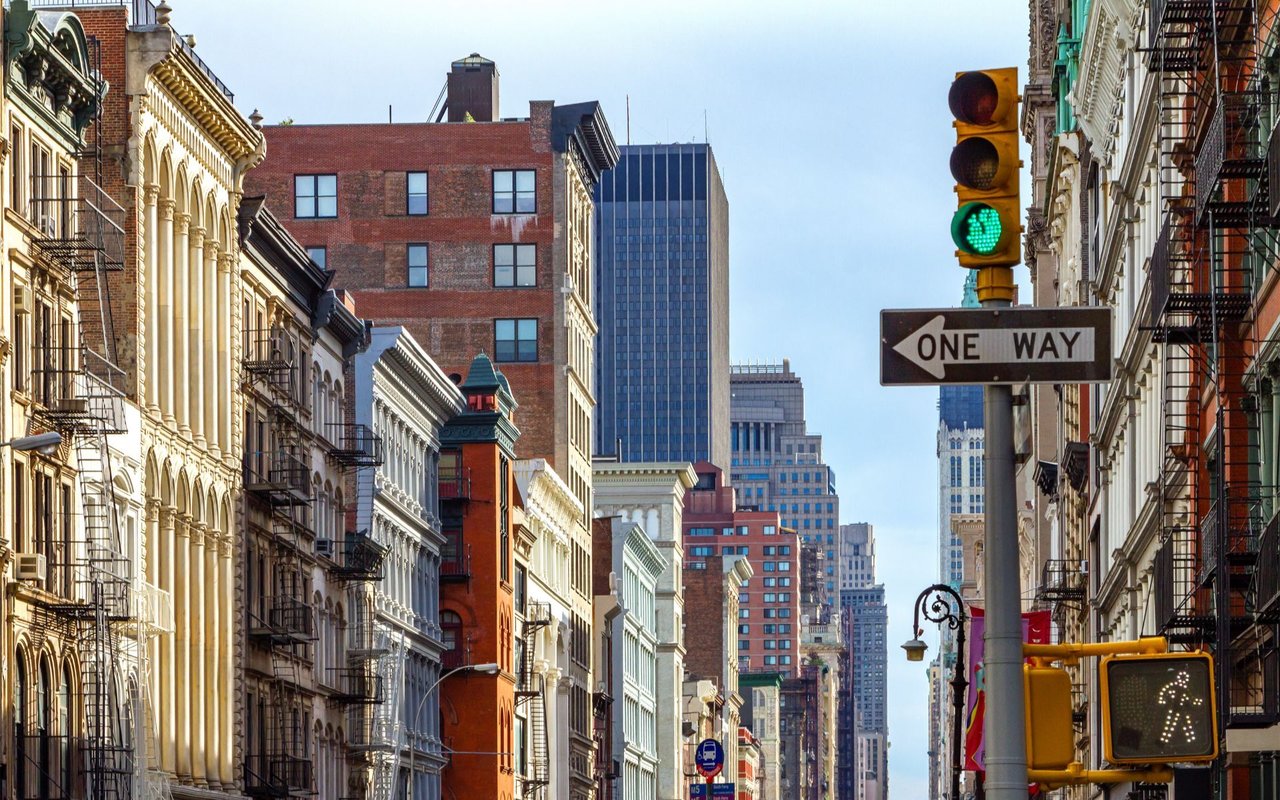
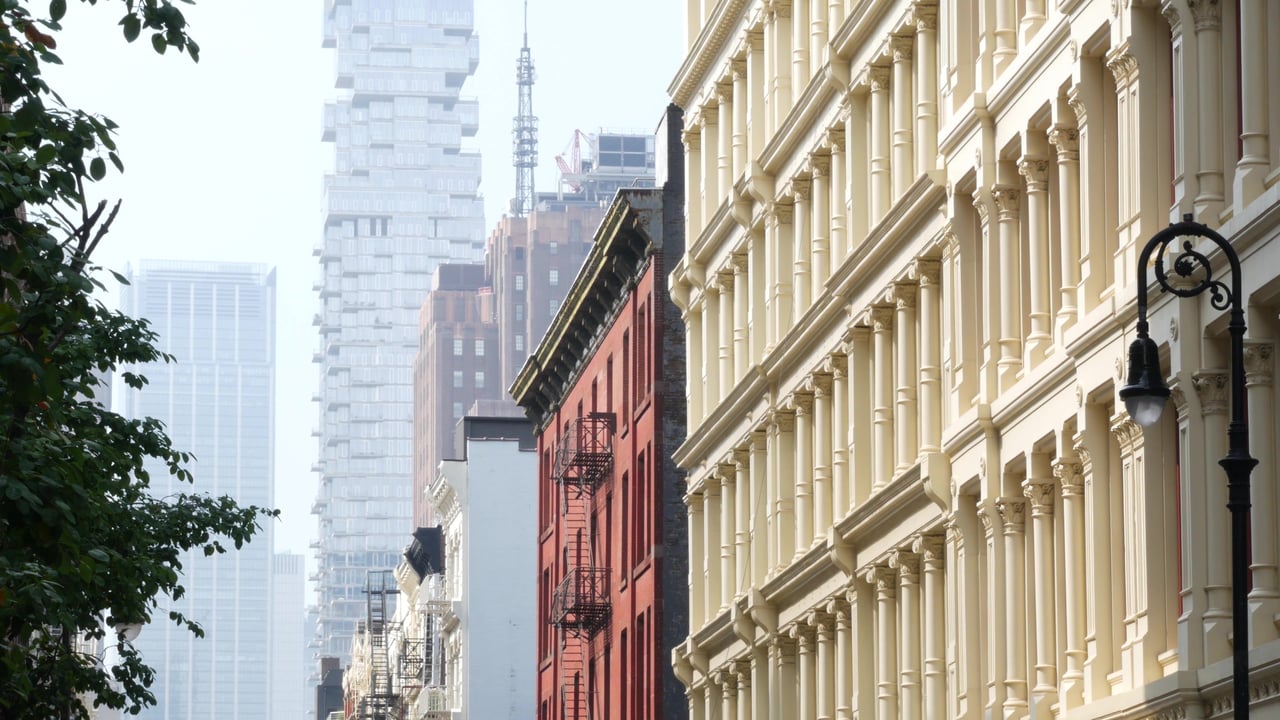
Understanding SoHo's real estate begins with understanding its bones. In the mid-to-late 19th century, the neighborhood became Manhattan's textile and commercial manufacturing district, and architects adopted cast-iron as the structural material of choice. It was cheaper than carved stone, decorative facades could be pre-cast in foundries and bolted together on-site, and its strength allowed for the oversized windows and slender interior columns that garment workers needed for natural light. The result is the highest concentration of cast-iron architecture in the world, much of it still standing exactly where it was poured 150 years ago.
By the mid-20th century, manufacturing had moved on, and SoHo emptied out into what locals once called "The Valley of Ashes." The neighborhood's second life began in the 1960s and '70s, when artists priced out of the East and West Villages began illegally occupying the vacant warehouses, drawn by cheap rent and the cathedral-like proportions of former factory floors. They invented the modern loft conversion, turning industrial space into live-work studios and seeding what would become the epicenter of the contemporary art world.
That history nearly disappeared. In the 1960s, urban planner Robert Moses proposed the Lower Manhattan Expressway, a highway that would have flattened SoHo entirely. A community coalition led in part by Jane Jacobs defeated the project, and in 1973 the city formally designated the SoHo-Cast Iron Historic District, locking in the cobblestones, fire escapes, and facades that define the neighborhood today. For buyers, that designation matters in concrete ways: facades cannot be altered, window replacements are regulated, and the architectural inventory is effectively fixed. Scarcity is built into the zoning.
Daily life in SoHo shifts dramatically depending on the day of the week and the block you happen to be standing on. Weekday mornings on Wooster or Greene Street are surprisingly quiet, with residents walking dogs across the cobblestones and grabbing espresso before heading to studios or offices. By midday, Broadway and West Broadway fill with shoppers and professionals, and by Saturday afternoon the main corridors take on the energy of a global destination, with street vendors, photo shoots, and tourist crowds layered onto the regular foot traffic.
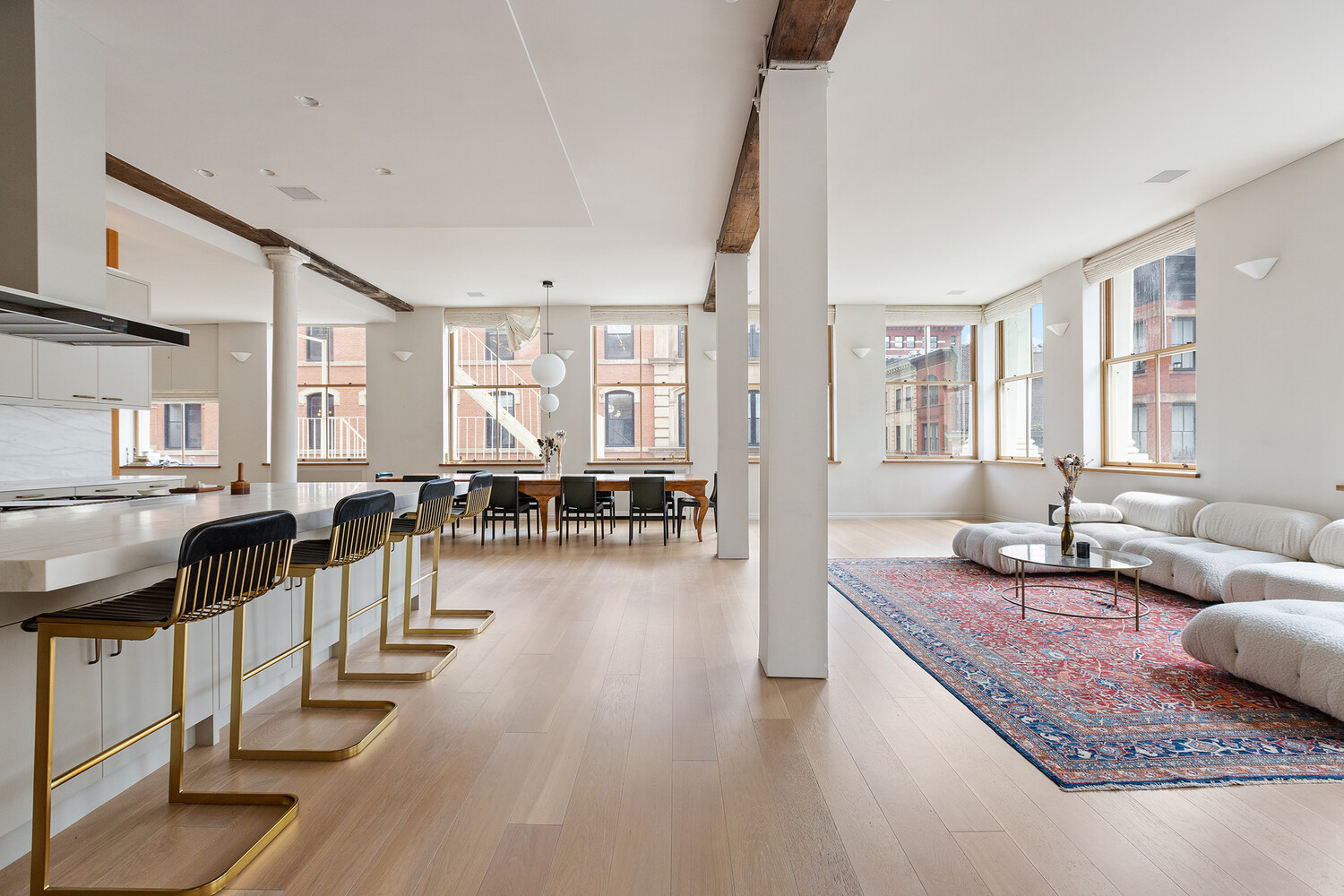
Most longtime residents adapt by drawing their own internal map of the neighborhood: Broadway and Prince for errands, Crosby and Mercer for quiet walks, the side streets for restaurants where you can actually hear your dinner companion. Loft living shapes the experience as much as the streets do. Residential spaces here tend to feature open floor plans, ceilings between 12 and 15 feet, exposed brick, original Corinthian iron columns, and oversized windows. It is a lifestyle that trades traditional residential comforts (yards, quiet, predictable parking) for proximity to culture, design, and the visual texture of historic Manhattan.
SoHo's restaurant scene is unusually deep for a neighborhood of its size, with a healthy mix of decades-old institutions and reservations-only newcomers. Balthazar, the Keith McNally brasserie that has anchored Spring Street since 1997, still functions as the neighborhood's living room, with its red leather banquettes, raw bar, and steak frites drawing everyone from finance executives to film directors. Raoul's, open since 1975, offers the quieter, moodier counterpoint, with its dim lighting, hidden garden, and the famously hard-to-get au poivre burger served only at the bar.
The newer wave is equally compelling. The Corner Store has become one of the most consistently buzzy reservations in the neighborhood, mixing vintage interiors with elevated American comfort food. Raku specializes in handmade udon and rewards anyone willing to wait for a seat in its minimalist Church Street space. Lure Fishbar, hidden below Mercer Street and designed to evoke a yacht interior, remains a reliable choice for sushi and oysters.
For pastries, Dominique Ansel Bakery is best known for inventing the Cronut, but locals tend to point newcomers toward the DKA, a caramelized kouign-amann that is arguably the real masterpiece. Croft Alley on Sixth Avenue has built a quiet following for its California-leaning menu and excellent matcha.
The bar scene runs from historic to contemporary. Fanelli Café has been operating since 1847, making it one of the oldest continuously running bars in New York, and its checkerboard floors and neon sign anchor the neighborhood's working-class memory. For a more polished evening, the bar at the Michelin-starred Le Coucou offers candlelit cocktails in one of the most beautiful rooms downtown, while The Blond at 11 Howard transitions from a daytime hotel lounge into one of SoHo's more exclusive late-night rooms.
If New York is the global capital of retail, SoHo is its showroom. The neighborhood's main commercial arteries run along Broadway, Prince, Spring, and West Broadway, but the most interesting shopping happens on the quieter side streets.
The flagships along Broadway are destinations in their own right. The Prada store at 575 Broadway, designed by Rem Koolhaas, features a sweeping wooden wave that doubles as a staircase and event venue and is widely regarded as one of the most important pieces of retail architecture built in the last 30 years. Nike SoHo at 529 Broadway runs in the opposite direction, packing a basketball trial court, a soccer zone, and customization stations into a multi-story experiential build-out.
Off the main strips, the neighborhood's curated boutiques tell a more interesting story. The Webster at 29 Greene Street occupies a six-story cast-iron building styled like a penthouse and curates pieces from Chanel, Balenciaga, and Valentino under one roof. Aimé Leon Dore on Crosby Street has become a cultural touchstone for menswear, with a dedicated espresso bar that draws lines of its own. Flying Solo at 419 Broome operates as a designer cooperative, where the person helping you on the floor may well have designed the piece you are trying on.
For vintage and archival fashion, What Goes Around Comes Around on West Broadway is the definitive stop, offering authenticated Hermès Birkins, vintage Chanel, and rock-and-roll memorabilia that draws stylists from around the world.
Though many of the mega-galleries that once defined SoHo have migrated north to Chelsea or south to Tribeca, the neighborhood's creative DNA remains intact. Jeffrey Deitch at 18 Wooster Street continues to launch important careers and stage the kind of large-scale, street-influenced exhibitions that helped define his reputation. The Drawing Center at 35 Wooster is one of the only museum-quality spaces in the country dedicated entirely to the medium of drawing, and Eden House of Art near Greene and Broome offers 25,000 square feet of pop and immersive installation work.
SoHo also houses two specialized institutions worth knowing. The Leslie-Lohman Museum of Art at 26 Wooster is the only museum in the world dedicated exclusively to LGBTQ+ visual art. The Judd Foundation at 101 Spring Street preserves the home and studio of minimalist artist Donald Judd exactly as he left it, and a guided tour there is one of the most powerful ways to understand what loft living actually meant in the 1970s.
The neighborhood's creative legacy was formalized by the Loft Law of 1982, which legally protected the artists who had been quietly living in commercial warehouses for decades. SoHo served as the working ground for Basquiat, Warhol, Haring, and Guston, and traces of that era still surface in the form of faded graffiti layered beneath the polished retail facades.
SoHo is not a green neighborhood in the traditional sense, and anyone moving here from a leafier part of the city should understand that upfront. What it offers instead is pocket parks and quick access to larger green spaces just outside its borders.
Vesuvio Playground on Thompson Street provides handball and basketball courts, a playground, and a summer pool that serves as a gathering point for local families. SoHo Square, the small triangular park at Sixth Avenue and Spring Street, offers a shaded bench and a moment of pause in the middle of a busy commercial strip.
For more expansive green space, residents walk. Washington Square Park sits about five to ten minutes north in Greenwich Village and functions as SoHo's de facto backyard, with its arch, fountain, and famously competitive chess tables. Hudson River Park, a short walk west, opens up miles of waterfront lawn, bike paths, and piers along the river.
Few neighborhoods in Manhattan match SoHo's subway density. The borders are essentially ringed by stations, giving residents access to almost every major line in the city.
Station | Location | Lines |
|---|---|---|
Prince Street | Broadway & Prince | N, R, W |
Broadway-Lafayette | Houston & Broadway | B, D, F, M |
Spring Street | Lafayette & Spring | 6 |
Canal Street | Broadway & Canal | N, Q, R, W, J, Z, 6 |
Spring Street (West) | Sixth Ave & Spring | C, E |
The result is a neighborhood where Midtown, the Financial District, and most of Brooklyn are within a single train ride. SoHo also carries a Walk Score of 100, and given that the neighborhood measures only about half a mile across, walking from one end to the other typically takes less than 15 minutes. Citi Bike stations sit on nearly every other block, making the bridges into Brooklyn and the West Side Highway bike path easily accessible.
The trade-off is congestion. Sidewalks on Broadway and Prince can become genuinely difficult to navigate on weekends, which is why long-term residents tend to route their daily errands through Crosby, Mercer, and Wooster.
SoHo sits within District 2, one of the most academically competitive public school districts in New York City, and families here have access to strong public and private options both within the neighborhood and just across its borders.
On the public side, P.S. 130 Hernando De Soto on the SoHo–Chinatown border is well regarded for its academics and arts programs. The Clinton School near Union Square offers an International Baccalaureate program for middle and high school students. Just north of Houston Street, P.S. 41 and P.S. 3 in Greenwich Village are popular elementary choices for SoHo families due to their progressive, community-driven approaches.
Private options include The Montessori Schools SoHo campus, which serves children from 18 months to 6 years; Léman Manhattan Preparatory School in the Financial District, a PK-12 program offering the IB diploma; and the historic Grace Church School and St. Luke's School in Greenwich Village, both highly regarded for their academics and ethics-focused curricula.
The SoHo real estate market is mature, low-inventory, and unlike almost anything else in Manhattan. Because landmark preservation laws govern the entire historic district, the housing stock is effectively fixed. New glass towers will not appear here; instead, the inventory consists of historic cast-iron lofts, a smaller number of boutique condo conversions, and a meaningful share of co-ops, many of which still operate under "Artist in Residence" (AIR) zoning that requires board approval for buyers.
Pricing reflects that scarcity. The median sale price sits in the range of $3.1M to $3.2M, with price per square foot generally tracking between $1,600 and $2,100. Condos command the highest premiums, averaging around $3.3M+ for a multi-bedroom unit, while co-ops trade at a relative discount with medians closer to $2.4M, though they typically come with stricter board requirements and higher down payment expectations. On the rental side, the median monthly rent is approximately $8,550, and luxury two- to three-bedroom lofts regularly clear $11,000 to $15,000 per month.
A few market dynamics are worth understanding before you bid. The luxury segment is overwhelmingly cash-heavy, particularly in a higher-rate environment, which gives all-cash buyers significant leverage in negotiation. Properties also tend to sit on the market longer than the Manhattan average, often more than 130 days, because serious buyers spend additional time on due diligence around building reserves and the capital expenditures associated with maintaining 19th-century cast-iron structures. Despite the longer timelines, values have continued to appreciate roughly 4% to 8% year over year. On the commercial side, retail occupancy has climbed past 84%, with global brands continuing to treat SoHo as their primary U.S. launchpad.
A handful of addresses define what is possible at the top of the SoHo market. 101 Spring Street, the former home and studio of Donald Judd, is not a building you can buy into, but it remains the architectural and cultural blueprint for the entire neighborhood. The Little Singer Building at 561 Broadway, completed in 1904, features one of the most intricate facades downtown, a combination of dark green cast-iron and red terracotta, and is one of the most photographed cooperative buildings in the area. 158 Mercer Street, the so-called New Museum Building, offers the kind of full-floor, column-and-arched-window residences that have made it a quiet favorite among high-profile buyers seeking discretion.
On the modern luxury side, 40 Mercer Street, designed by Jean Nouvel and developed by André Balazs, blends industrial heritage with hyper-modern amenities behind its distinctive blue-and-red glass facade, with a private underground garage and indoor pool. 20 Greene Street, marketed as Aether Above SoHo, recently set neighborhood records with a multi-level penthouse offered at $45 million, a benchmark for what preservation-grade conversions can command. 565 Broome Street, designed by Renzo Piano, sits on the western edge of the neighborhood and is notable for its curved glass corners and unobstructed Hudson River views, a rare offering in a neighborhood otherwise defined by mid-rise grid structures.
SoHo has shifted considerably from its 1970s identity as a working artist enclave. Today it is one of the wealthiest and most education-dense neighborhoods in the United States, with a population of roughly 12,000 residents and a median age in the high 30s. Nearly 64% of households are non-family setups, meaning single residents or couples without children, and the average household size is just two people.
Income levels here rank among the highest in the country. The average annual household income comfortably exceeds $285,000, with the majority of households clearing $150,000 or more. An estimated 96% to 98% of the workforce is white-collar, and the resident base today is heavily weighted toward finance executives, tech founders, fashion designers, gallery owners, and entertainment figures who value the neighborhood's discretion and cultural fluency. A small number of the original artists remain, generally those who own under historically protected arrangements.
The ownership picture is unusual for a market this expensive: roughly 75% of SoHo residents rent, while only 25% own. The high rental share reflects a transient mix of international residents, corporate executives, and creative professionals who prefer flexibility over a multi-million-dollar capital commitment.
The honest case for and against SoHo comes down to how you weigh aesthetic and access against cost and crowds.
On the upside, the neighborhood offers a daily aesthetic experience that is genuinely rare. Cobblestone streets, cast-iron facades, and protected architecture create a sense of place that does not exist elsewhere in Manhattan. The retail and dining scene is among the best in the world, and the loft inventory provides residential spaces, full floors, soaring ceilings, oversized windows, that are nearly impossible to replicate. The subway connectivity is among the strongest in the city, and the central location puts Midtown, the Financial District, and Brooklyn within easy reach.
On the downside, the same characteristics that make SoHo desirable also create friction. Weekend foot traffic on Broadway, Prince, and Spring Streets can feel overwhelming, particularly during the holiday season. The cost of living is among the highest in the United States, from real estate to daily expenses. Historic buildings, while beautiful, often lack the soundproofing and modern systems of newer construction, and the neighborhood's lack of large parks within its immediate borders is a real consideration for families.
SoHo tends to work best for buyers who genuinely want to live inside the city rather than near it. Creative professionals, fashion and design industry leaders, executives who travel often and want to walk to dinner when they're home, and anyone drawn to the texture of historic architecture will find few neighborhoods that match it. If your idea of a dream home is a sun-filled loft with original columns, and the energy of a global retail district outside your door reads as a feature rather than a bug, this is one of the few places in Manhattan that delivers.
If, on the other hand, you prioritize quiet residential streets, immediate access to large parks, modern full-service amenity buildings, or a neighborhood that empties out on weekends, you may find a better fit in Tribeca, the West Village, or Greenwich Village. Each offers a different balance of the same downtown sensibility with fewer trade-offs around crowds and noise.
Buying or selling in SoHo is not like buying or selling anywhere else in New York. The interplay of landmark preservation, AIR zoning, co-op board dynamics, and a cash-heavy luxury market means that the right guidance often determines whether a deal closes on the terms you want, or closes at all.
The James Weiss Team at Corcoran has built its practice around exactly this kind of nuanced, high-stakes Manhattan transaction. With more than $500 million in completed deals, a significant share of them off-market, the team brings a family-office approach to residential real estate: discreet, detail-oriented, and built around the people involved rather than the price tag. If you are considering a move in or out of SoHo, exploring an off-market opportunity, or simply trying to understand what your current home is worth in today's market, the team is available for a confidential conversation.
You can reach the James Weiss Team at (201) 956-8739 or [email protected], or visit the office at 590 Madison Avenue, 8th Floor, New York, NY 10022.
There's plenty to do around SoHo, including shopping, dining, nightlife, parks, and more. Data provided by Walk Score and Yelp.
Explore popular things to do in the area, including Alberta Ferretti, Nanamica, and Etro Usa.
| Name | Category | Distance | Reviews |
Ratings by
Yelp
|
|---|---|---|---|---|
| Shopping | 0.2 miles | 4 reviews | 4.5/5 stars | |
| Shopping | 0.21 miles | 0 reviews | 0/5 stars | |
| Shopping | 0.22 miles | 1 review | 4/5 stars | |
| Shopping | 0.26 miles | 0 reviews | 0/5 stars | |
| Shopping | 0.32 miles | 0 reviews | 0/5 stars | |
| Shopping | 0.39 miles | 4 reviews | 2/5 stars | |
| Shopping | 0.42 miles | 0 reviews | 0/5 stars | |
| Active | 0.35 miles | 0 reviews | 0/5 stars | |
| Nightlife | 0.25 miles | 0 reviews | 0/5 stars | |
| Beauty | 0.21 miles | 0 reviews | 0/5 stars | |
| Beauty | 0.35 miles | 1 review | 5/5 stars | |
|
|
||||
|
|
||||
|
|
||||
|
|
||||
|
|
||||
|
|
SoHo has 6,453 households, with an average household size of 2. Data provided by the U.S. Census Bureau. Here’s what the people living in SoHo do for work — and how long it takes them to get there. Data provided by the U.S. Census Bureau. 11,824 people call SoHo home. The population density is 47,500 and the largest age group is Data provided by the U.S. Census Bureau.
Total Population
Population Density Population Density This is the number of people per square mile in a neighborhood.
Median Age
Men vs Women
Population by Age Group
0-9 Years
10-17 Years
18-24 Years
25-64 Years
65-74 Years
75+ Years
Education Level
Total Households
Average Household Size
Average individual Income
Households with Children
With Children:
Without Children:
Blue vs White Collar Workers
Blue Collar:
White Collar:
Explore Other Neighborhoods
590 Madison Ave 8th Flr New York, NY 10022
590 Madison Ave 8th Flr New York, NY 10022